Come With Me
The Over-60s Dance Company Reshaping Who Gets to be a Dancer
As a child I would watch myself in the mirror, moving to the music, imagining the dancing career that lay before me. This body was made to dance, I was sure of it. I convinced my parents to send me to lessons. At the foot of a frigid ballet teacher, I remember joylessly counting my way through the steps, chest on fire, blotchy all over, crippled by self-consciousness – and so, when someone told me that I didn’t have the body to be a dancer anyway, I bowed out.
Recently, decades later, I found myself in another dance class. This time, at one of the leading dance venues in the world: London’s Sadler’s Wells Theatre. Though nearing 40 I was young for the class. The cohort ranges in age from 60 to 85, a mix of Londoners and like a lot of Londoners many with roots to somewhere else. Sharing their favourite dance styles, Bernie Durso, 67, says she’s ‘a mad keen rock and roll rockabilly fan’, Almeric Johnson, 85, says he likes ‘jiving’, Isidora Joseph says she’s ‘a party dancer more than anything’ and Monica Duck, 72, ‘an afrobeat person. I like to dance to the old ska records, old soul records, something from my roots.’ As for Margaret Gaskin, 72, attributing her rhythm to being brought up in Trinidad, watching Calypso dancing in the streets, she says: ‘I just like winding. You know winding?’ She raises a hand to pause me, shuffles onto her feet, and tells me to cover my baby’s eyes before she begins winding her hips in wide tight circles.
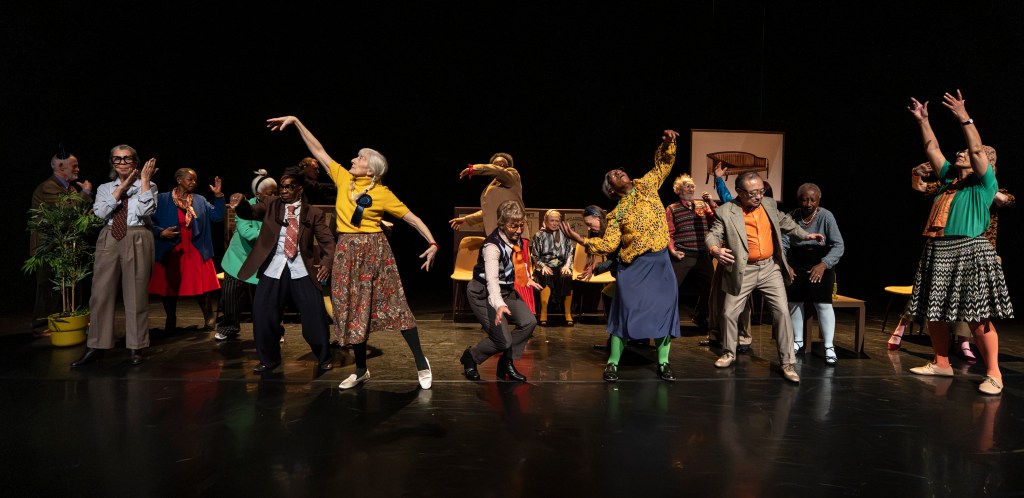
The Company of Elders is a dance company with two unusual barriers to entry: you should be over 60 to join and have no prior experience of professional dance. It grew out of the Lilian Baylis Senior Citizens Club, a group of older local community members who would gather at Sadler’s Wells Theatre to watch and talk about dance. One day in the early 90s, apparently inspired by a royal visit to the theatre, the members wanted to be seen doing something more physical to capture the queen’s attention. Making their transition from sedentary to active, observer to performer, senior to dancer, the Company of Elders was born. Each week the members gather with top choreographers and dance artists to workshop a variety of dance styles – hip hop, ballet, salsa, disco – and they work towards performances on some illustrious stages, from Sadler’s Wells to the South Bank Centre, the Venice Biennale, and festivals from London to Japan.
Though I’d intended to only observe the class I’m encouraged to join in. The rehearsal studio is flanked by floor to ceiling windows which look onto a row of trees, losing their leaves in the autumn air. The facilitator leading us, dancer and psychotherapist Carys Staton, invites us to seek ‘expansion’ and ‘curiosity’, to explore the way our minds move our bodies, to feel the movement from the inside rather than as our performing selves. Referring to the Alexander technique, she says ‘how we think about how we move impacts the way we move.’ We’re told to imagine eyes all over our head and to let these eyes lead the way, to stretch our bodies in various directions. She invites us to imagine the juicy sinewy fascia beneath our skin; describes our stretching waving bodies as seaweed in a sea.
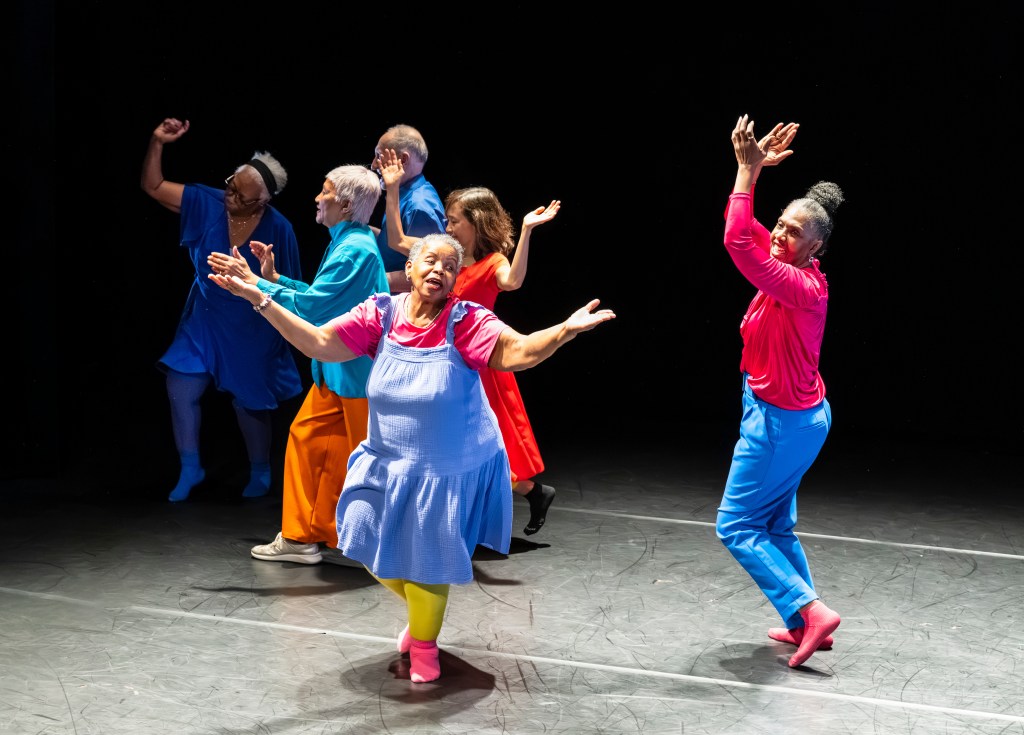
The focus on the internal is apt. Somatic practices which prioritise how a movement feels from the inside rather than how it looks on the outside are used amongst both dancers and therapists. But it’s also wrapped up in the evolution of contemporary dance. Embracing authenticity, personal experience, and presence over technique, modern dance movements profoundly reshaped attitudes around who gets to move on stage and how. By challenging more traditional dance forms like ballet, avantgarde pioneers explored everyday movement – the wonder of walking, the depth of gesture – they slowed things down, employed minimalism, and in doing so, made room to creatively explore the wider human experience. It paved the way for dance companies for older movers which are now flourishing around the world, by essentially broadening expectations of who has the body of dancer, who has the right to dance.
The Company of Elders was a pioneer within this movement, and it speaks volumes for Sadler’s Wells, as the foremost contemporary dance venue in the country, that a dance company for a group of people with no prior dance experience and limited movement is its only in-house dance company. Elaine Foley, producer of the Company of Elders, says: ‘I don’t need a certain type of perfection we have in our mind of perfect unison. There’s also something satisfying about something being really real, and I think that’s why the audience connects to it, because when you watch it you’re not like “oh my god, I could never do that”, instead you’re like “oh my god, I could do that.” And that’s what we want.’
This philosophy calls to mind something Staton says to the class while warming up, ‘move in a way that says not “come watch me” but “come with me”.’ The dancers appear to take great care stretching towards their toes, rising slowly, lifting their arms through the air, moving precious things. The warm-up is performance-worthy. Beautiful to watch. What makes these bodies that have known long lives, crossed seas, birthed babies, survived teenagers, lost loved ones, done decades of laundry, cooked and cleared away countless meals, so entrancing in their collective unwinding?
For the professionals who pioneered dancing into old age, we bring life experience into creative expression when we dance. Anna Halprin, dancing into her 90s, explored the healing power of movement for dancers and non-dancers alike. In Seniors Rocking, performed in a Californian care home, residents begin the dance on rocking chairs lined up along a lake, some stay seated throughout.
Kazua Ohno began dancing in his 50s and into 100, co-pioneering the Japanese dance form Butoh through which darker themes of death and decay could be explored.
Pina Bausch continued to use the same performers in her shows as they aged. She famously said of her dancers ‘I’m not so interested in how they move, but what moves them.’ In 1998 her show Kontakthof was performed entirely by a cast of over-60s who were untrained in dance.
More recently Jerome Bel’s show at London’s South Bank Centre featured people across spectrums of age and ability. In this more inclusive wave of dance work, older dancers bring vulnerability, life experience, and gravitas to the stage, which emerges as powerfully as the tricksy techniques more commonly associated with professional dance.
One of the dancers in the company, Rachel Thompson, sympathises with the choreographers they work with: ‘they’re used to working with people top of the bill – fit, on the ball, fast to learn – then suddenly, they come and work with varying geriatrics of all different shapes and sizes and backgrounds… And we’re all a bit bolshy! Because we’ve all got to the age where, you know?’
Despite this, the group look to me like they’re managing the steps just fine. While I on the other hand display incredible ineptitude with my hips as we move into the choreographed portion of the class. Many of the elders admit they prefer improv, where there’s less of a need to follow steps, and after a period of set choreography, there is a growing sense of frustration in the room. Staton turns off the music and tries a new tact: ‘Think of what you would do if you were dancing for pleasure, at a party, in your kitchen, at a wedding.’ Quoting fellow choreographer and colleague Michael Keegan-Dolan she says, ‘Movement should be what you do in your kitchen after a few old-fashioneds.’ She fiddles with the playlist and Nina Simone’s Baltimore comes on. Things shift. There’s a sudden levity in the room, two hands slap together, shoulders relax, people are bobbing their heads to the beat. Staton laughs as they begin to move more naturally together – ‘as soon as you clock that your friends are there, you’re like yes! I love to dance.’
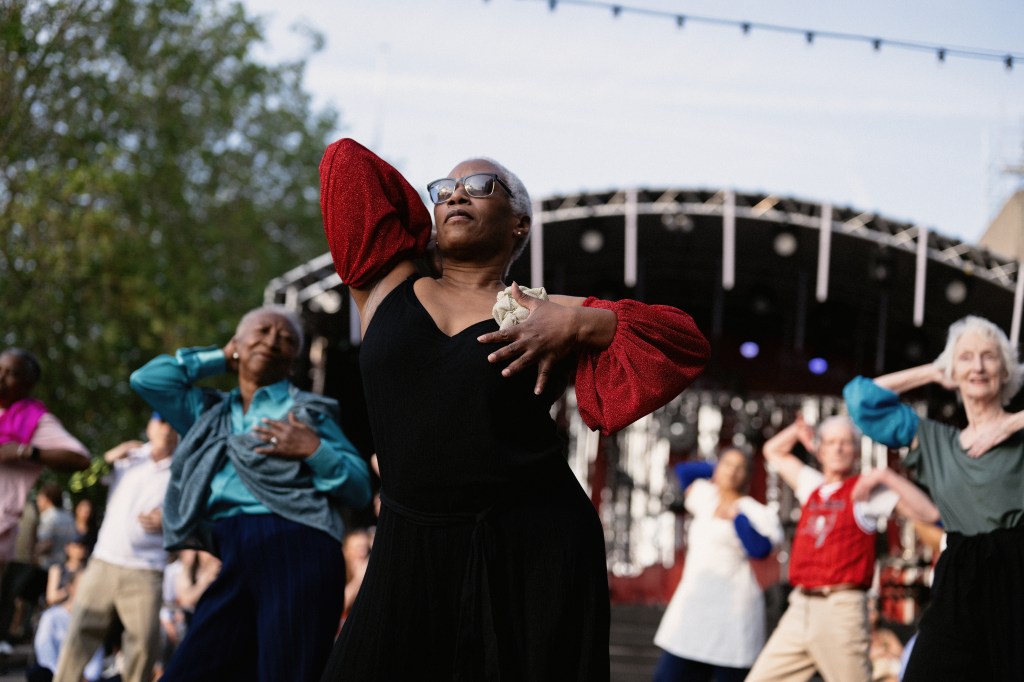
Since a BBC documentary about the Company of Elders aired in 2009, the waiting list to join the company grew exponentially. Individuals get a maximum of five years in the company before moving on to make room for others. And the audition process happens via dance classes at local libraries and community centres. Selection is informed by more than dance ability. As Foley explains, ‘Sadler’s Wells is an international company, in London, we intentionally look for difference in dancers – not only physical difference, but different personalities too…. The range of dance styles is intended to give different members a chance to shine.’ The group represents London at its best, and through this inclusive model, the company appears as an invitation for all. It’s not ‘come watch me’; it’s ‘come with me’.
Duck says she had no dance experience whatsoever when she began. ‘My passion is really music. Music and movement. I feel it’s in your body really. I love the old 60s and 70s music because I had such a great time then.’ She speaks openly of her life, about moving over to the UK from Jamaica when she was 10 after being left by her parents for a five-year-period with relatives back home, the sense of abandonment which she brought into her work later in life, as a social worker specialising in adoption and fostering – ‘my experience enabled me to understand what the children were going through’. She shares the story of a broken pact with her sister in which they’d sworn to move back to Jamaica as soon as they could afford it, but Duck met someone, a white British man whom she married, and throughout their relationship they weathered racism from both sides. She says she feels ‘a bit like a trendsetter in London – though London is unique – where there are so many mixed relationships. I used to be able to count them.’ She speaks warmly of her marriage, two daughters, holidays in France, the joy of watching her daughter give birth to her first grandchild – ‘to see her coming into the world what appeared to me easily – I’m sure my daughter wouldn’t describe it as that – like a little seal, slipping up.’ And she speaks stoically of the loss of her husband, of getting covid, being in ICU, being on dialysis, not being as fit as she used to be, about the long journey to understand what her parents did, of not feeling lucky then, but feeling lucky now.
Each dancer is full of stories. Johnson recalls being sent to Bournemouth from Bermondsey when London was bombed in the war and coming back ‘posh’. Durso says after a lifetime of wanting to dance she eventually found herself on stage. There, she looked out into the darkness and thought: “mum, dad” – she taps my shoulder – ‘I’m gonna cry. “It only took me, what? 50 something years to get here.”’ Roberto Ishii describes his childhood growing up in Sao Paulo where he would join in the carnival festivities and how amazed people were to see him dancing, he’d hear them shouting: “look, it’s a Japanese”.
In recent decades, the aging body has been increasingly explored in the dance world. In Meredith Monk’s Education of a Girlchild, she analyses the changing shape of a gesture from girlhood to middle age to older age. But beyond the changes that affect us universally, as human bodies atrophying, how do our specific experiences shape the way we look and move? Are our bodies, gaits, expressions, gestures, informed by our personal narratives and emotional responses to these narratives? Are our regrets and resentments weighing us down? Can we find grace in certain forms of surrender? These ideas seem both fanciful and incredibly obvious. The idea that trauma shapes our brains and bodies became more widely considered with the publication of Dr Bessel Van der Volk’s The Body Keeps the Score. According to somatic psychology, stress and trauma cause muscle holding patterns – that clenched jaw and those hunched shoulders become postural habits. The idea reminds me of something adults used to say when we were children pulling horrible faces: Beware, they said, the wind will change, and that expression might stick. But for practitioners of somatic theories, from followers of Feldenkrais to the Alexander technique, to yoga, life will have its way with your body, burdening it with aches and pains, but there are movements to work your way through them.
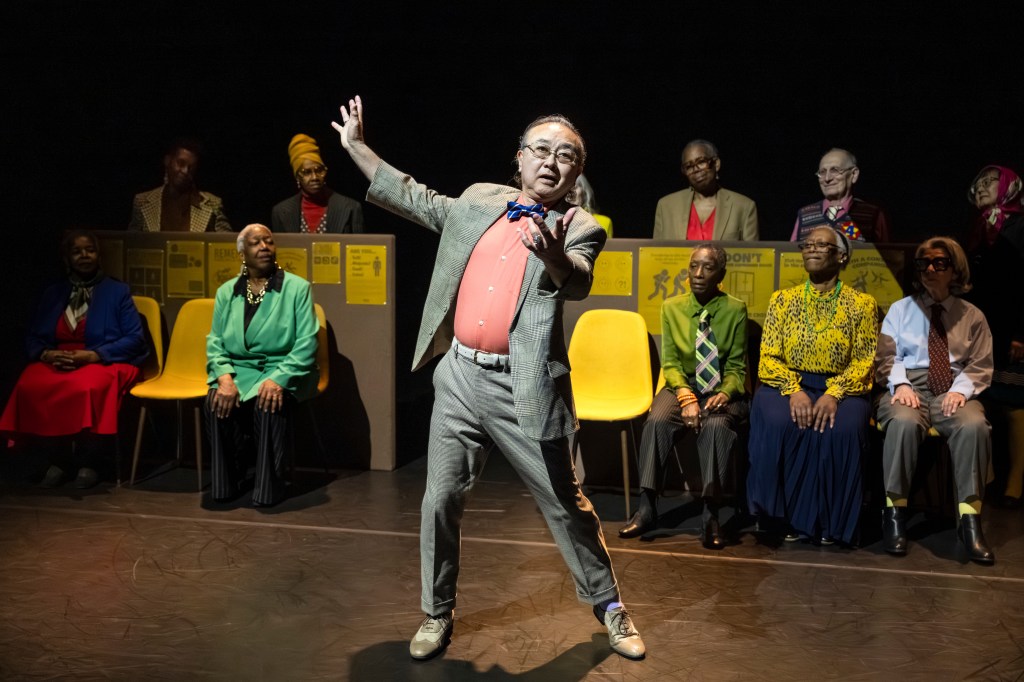
In a big fur coat and Elton John-style sunglasses, Ishii speaks with great passion about dance and the life he’s made for himself here in London. He considers his Company of Elders sessions therapy. He says, ‘I suffer from depression because of many things, family that don’t accept me because I’m gay, and being alone, and now with this problem with my leg and my heart, many things, but here, at least for two or three hours, I forget all my problems and I’m doing what I love: dancing, laughing, chatting with friends. After the rehearsals we come here, we have lunch, discuss things, laugh again, it’s like being at Sunday lunch with family.’
Beyond the obvious social and physical benefits for the dancers themselves, the performative aspect of the Company of Elders means their work enters the realm of culture and gives something to society too. These dancers show us a different version of growing older – one in which older people aren’t tucked away or playing the old witch in the background but on centre stage holding our attention, their bodies full of expression, moving and telling stories in their wake, producing work that is genuinely entrancing. It turns conventional expectations of the world on their head: watching someone you’d give your seat to on a bus – a body seemingly frail – stamp their feet with gusto, or circle a dance floor to dizzying effect, or sway sensually in the spotlight.
I lucked upon two of the last seats to a Company of Elders show some years ago. In Last Night a DJ Saved My Life, a woman has had her heart broken but her best friend Maggie persuades her to go out clubbing, there they reminisce about old flings and flames. Thompson bobs her head in the DJ box, the dancers wind like teenagers in the club, and Ishii, alone in the spotlight, thrusts his hips. The show was choreographed by Bagsy, ‘dancer, actor, model, stuntman’, according to his Instagram page where he has 31,6K followers, and a few more in the Company of Elders. He was mentioned unprompted by almost all the dancers I interviewed. Duck calls him ‘one of these larger-than-life choreographers, full of energy and dynamism. We all loved him I think.’ Durso says she hadn’t been feeling well that term but ‘the gentleman who was teaching, Bagsy, he came over and said, ‘it doesn’t matter, we can do this sitting down,” and he started waving his arms about. He didn’t leave me out at all!’
Ishii raves about his directing and overhearing Thomspon interrupts, ‘Bagsy?’ Don’t even mention him to me, I get into a hot flush.’
‘He is adorable,’ Ishii says.
‘He’s kind, he’s gentle, he’s very nice to look at. He’s a fabulous mover,’ says Thomson.
‘He pays attention to each dancer,’ adds Ishii, ‘And he speaks Japanese fluently.’
‘Yes, he’s clever! shouts Thompson, ‘He was good at finding what we were good at. He found our strengths. He gave us confidence!’
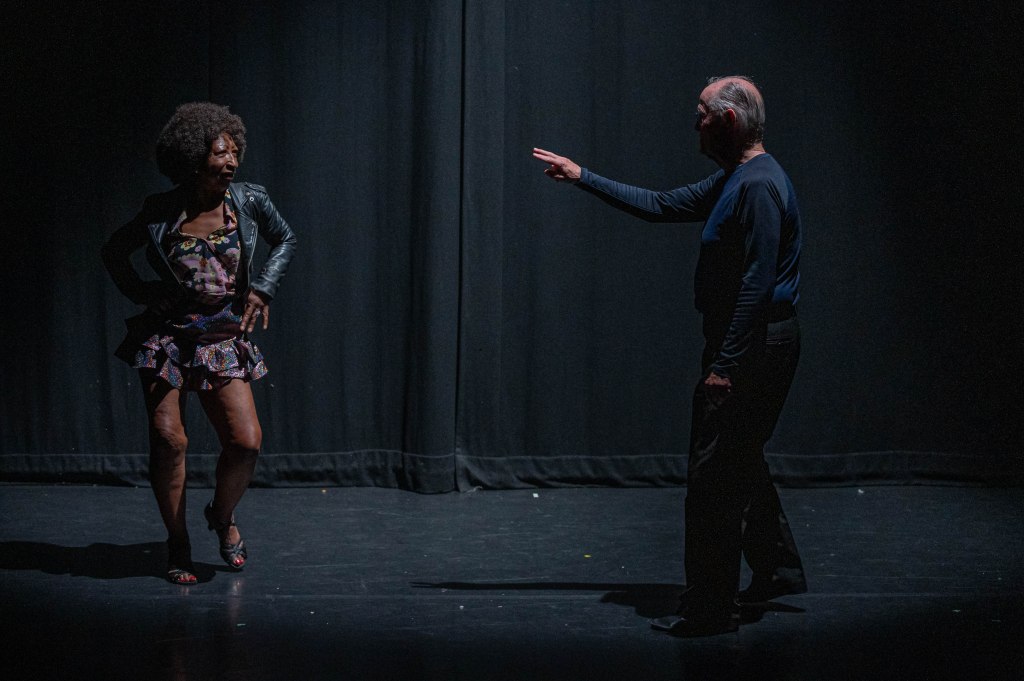
Overcoming self-consciousness and finding the tenacity to dance, let alone on stage, can feel insurmountable. It takes tremendous courage. Many report losing themselves on stage, finding their flow in the stage lights. Ishii says, ‘When you’re about to enter the stage, I feel so excited and nervous and insecure but as soon as I enter it’s like ‘poof’, something explodes inside me, and I think people deserve the best, so I have to do the best.’
Thompson says, ‘At first, I thought I can’t do it, I can’t do it, I can’t do it, and none of us could do it, quite frankly, but now, I think I like it now. I get scared, I get nervous, but it gives us something to work towards. You can go down to the community centre and learn whatever sort of dance you want but to learn something you’re going to put on stage it gives it another dimension, doesn’t it?’
She has five grandchildren under seven and she says they feel very proud, regularly telling their friends ‘granny’s a dancer.’ She says, ‘I’ve done nothing in my life where I’m going to leave a legacy, but I like the idea that the grandkids will go past with their own kids and go ‘granny used to dance here’. They won’t need to know that I was over 60 and couldn’t remember the steps and but just the fact that I was at Sadler’s Wells, dancing, that’s just the legacy I’d like to leave…. If somebody said to a person who has no professional dance experience, that when you’re 68 you’ll be dancing on stage at a festival in Japan you might think: well, life is worth living.’
At the end of the performance I watched, the audience descended on stage into what became a party. Loved ones who had been seated in the audience embraced their dancing parents and grans and grandads on stage. An elderly man kicking his legs back like a skipping schoolgirl pushed along a dancer who had performed from her wheelchair, they looked like skaters gliding on ice. My husband carried our two-year old onto the stage and bounced him around among the dancing strangers. The whole thing was life-affirming, like nothing I’d ever watched, or been drawn into. It forged me as a fan, a newfound groupie of the Company of Elders. Though when Thompson asks during our interview what had piqued my interest in writing about them, she assumes I’m a dancer and looks surprised when I correct her. ‘Really?’ she says, ‘because you look like a dancer.’
I thank her gushingly, as it goes without saying that I still do hope to be a dancer when I grow up. But what I should have said, and what I’ll say next time, if anyone ever tells me again that I look like a dancer, is: ‘so do you.’ And so do you, and you, and you.

